 ultimate-guide
What Type of Marketing Is Best for Real Estate?
Table of Contents
- Why Real Estate Marketing Fails Without a Channel Mix
- Real Estate Marketing Strategies for Agents: A Step-by-Step Plan
- Drone Photography for Real Estate Listings: Why Visual Content Wins
- Best Real Estate Marketing Tools 2025: What Actually Saves Time
- How to Measure ROI and Attribute Leads to the Right Channel
- Compliance, Privacy, and Advertising Rules Every Agent Should Know
- Conclusion: Choosing What Is Best for Your Real Estate Business
- Frequently Asked Questions
Last Updated: October 7, 2026
Why Real Estate Marketing Fails Without a Channel Mix
The honest answer to the question "What type of marketing is best for real estate?" is that no single channel wins.
Most agents fail at marketing for a predictable reason: they run one channel, get inconsistent results, and abandon it for the next shiny option. A Facebook post here, a postcard drop there, and no way to tell which produced the phone call.
The fix is a mix, matched to your niche, budget, and experience level.
Real Estate Marketing Strategies for Agents: A Step-by-Step Plan
Real estate marketing strategies for agents work best when built in sequence: define who you serve, set what you can spend, then build the presence that captures demand. Skipping straight to advertising without the first two steps wastes money on the wrong audience. The plan below adds what most idea roundups leave out, a direct channel comparison, realistic budget ranges, and a recommended mix by agent type.
Step 1: Define Your Niche and Target Audience
Pick one segment and build everything around it. The National Association of REALTORS® marketing resources discuss choosing a niche to build expertise and focus, and the logic holds: a first-time-buyer specialist and a luxury waterfront agent need entirely different channels, imagery, and messaging.
Write down three things: the property type, the price band, and the buyer profile. "Move-up families in the $300K-$450K range" is a niche. "Anyone buying a home" is not.
Step 2: Set a Realistic Marketing Budget
A common approach is to allocate a fixed monthly figure and divide it by channel rather than spending reactively. Most practitioners find that new agents working with limited budgets should weight free and low-cost channels heavily, social media, community networking, and referrals, while established agents with a pipeline can shift more toward paid search, direct mail, and professional visual assets.
A workable starting framework many agents use:
- New agents (first 12 months): keep total monthly spend modest and concentrate it on one paid channel plus free organic effort. Referrals and sphere-of-influence outreach cost time, not dollars.
- Established agents: split spend between a lead-generation channel (paid search or paid social) and a retention channel (email, direct mail, or a CRM-driven drip).
- Luxury and niche specialists: invest more per listing in professional photography, video, and aerial media, because presentation quality drives the price band you attract.
Track spend per channel monthly. If a channel cannot be measured, it cannot be justified.
Step 3: Compare the Channels Before You Commit
The query asks what type of marketing is best for real estate, and the honest answer is that channels differ on cost, reach, lead quality, time to results, and fit. Compare them on those five dimensions before you spend:
- Local SEO and Google Business Profile: low direct cost, slow to build, high-intent leads. Best for agents with patience and consistent content output.
- Social media (organic): low cost, broad reach, variable lead quality. Best for agents who can post consistently and show personality.
- Paid search and paid social: fast results, higher cost per lead, scalable. Best for agents with a proven follow-up system and a budget to test.
- Email and drip campaigns: very low cost per send, strong for nurturing past clients and referrals. Best once you already have a contact list.
- Direct mail: moderate cost, strong local recall, hard to attribute. Best for farming a specific neighborhood.
- Video and aerial media: higher per-asset cost, strong listing differentiation, shortens time on market. Best for sellers who need to stand out in a crowded price band.
- Networking and community outreach: time-intensive, low cash cost, highest referral quality. Best for long-term pipeline building.
No single row wins. The best mix depends on your goal, budget, and experience level.
Step 4: Build Your Online Presence and Local SEO
Your real estate website is the hub every other channel points to. Local SEO, search engine optimization, and complete online profiles on local directories and realtor registries determine whether buyers find you at all.
- Claim and complete your Google Business Profile
- Publish neighborhood-specific content on your site
- Keep your name, address, and phone consistent across every directory
- Ask past clients for reviews and respond to each one
Step 5: Match the Mix to Your Situation
A one-size-fits-all plan fails because a new agent and a luxury specialist need different channels. A practical starting point:
- New agents: local SEO, organic social, networking, and referrals. Add one paid channel only after follow-up is consistent.
- Established agents: paid search or paid social for volume, email and CRM drip for retention, and professional visual assets for listings.
- Luxury specialists: premium photography, video, and aerial media, plus targeted paid social and direct outreach to a defined buyer profile.
- Rental professionals: listing syndication, local SEO for neighborhood queries, and consistent social content showing available units.
- Small agencies: a shared CRM, one paid acquisition channel, and a repeatable listing-media package across the team.
Drone Photography for Real Estate Listings: Why Visual Content Wins
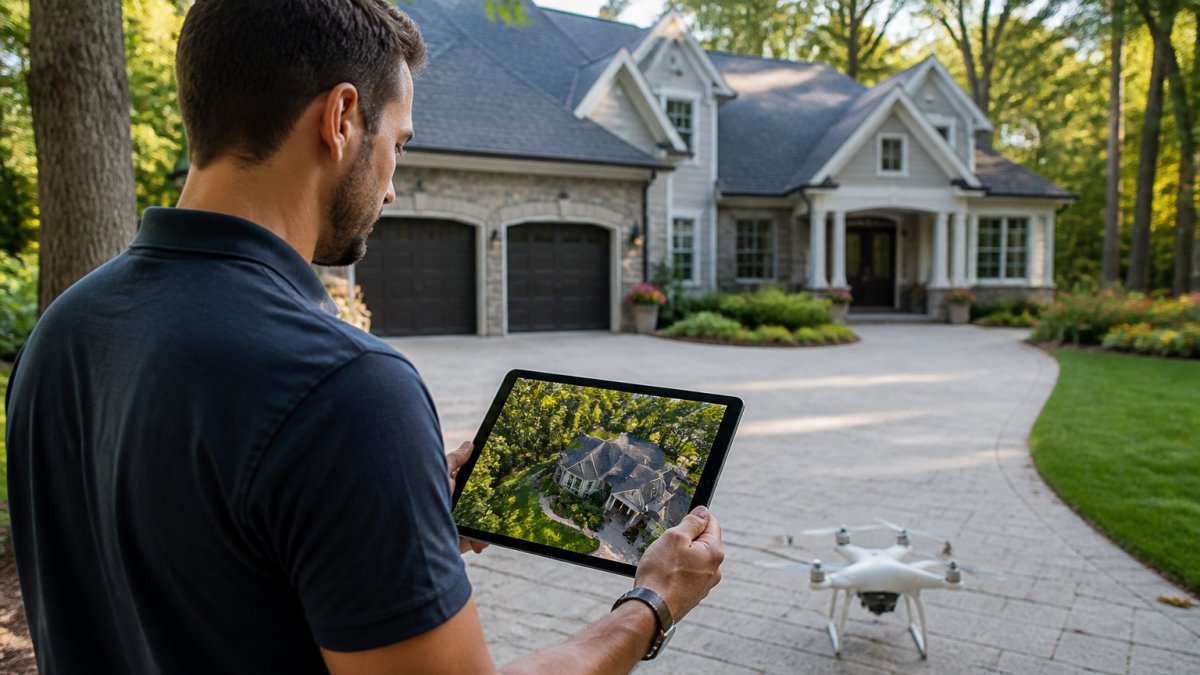
Drone photography for real estate listings changes how buyers evaluate property before they ever visit. Aerial photos and video show lot lines, roof condition, neighboring structures, and surrounding terrain in a single frame, context a ground photographer physically cannot capture.
This is where Lake County Aerial Solutions operates. Our FAA Part 107 certified pilots deliver high-quality aerial photos and video within 24 hours, along with accurate roof reports with square footage and edge measurements. For remote buyers evaluating land, that documentation replaces a wasted trip.
Pair aerial media with virtual tours and professional property photography. Visual content earns more engagement and shortens time on market.
Best Real Estate Marketing Tools 2025: What Actually Saves Time
The best real estate marketing tools 2025 has to offer fall into two groups: platforms that manage campaigns and services that produce assets. Match the tool to the job rather than buying an all-in-one suite you will use a fraction of.
| Tool | Category | Best For |
|---|---|---|
| Lake County Aerial Solutions | Aerial media and roof data | Listings needing drone photography and measurement reports |
| SharpLaunch | Property marketing platform | Commercial teams organizing property marketing |
| Buildout | Property marketing platform | Commercial real estate marketing workflows |
| Matterport | Visual walkthroughs | Agents presenting listings online |
| Market Leader | Marketing automation | Coordinated social, video, and automated campaigns |
| LocaliQ | Research and advertising | Planning channels with buyer research |
For most residential agents, the highest-return additions are a CRM for follow-up and a reliable source of professional visual content. Marketing automation handles drip campaigns and listing alerts, but only after you have leads worth nurturing.
How to Measure ROI and Attribute Leads to the Right Channel
Attribution answers a simple question: which channel produced this client? Without it, you are guessing where next month's budget should go. Most competitors stop at "use a CRM and ask how they found you." The gap they miss is the math, the four numbers that tell you whether a channel is actually worth its spend.
The Four Numbers That Matter
Track these for every channel, every month:
- Cost per lead (CPL): total channel spend divided by leads generated. A channel spending $600 and producing 12 leads has a $50 CPL.
- Lead-to-client conversion rate: clients closed divided by leads generated. If 12 leads produce 2 clients, conversion is roughly 17%.
- Cost per acquisition (CPA): total channel spend divided by clients closed. $600 spend on 2 clients is a $300 CPA.
- Return on spend: total commission from closed transactions divided by channel spend. If those 2 clients produced $12,000 in commission against $600 spend, the channel returned 20x.
A channel with a high CPL can still be your best performer if its conversion rate and commission per client are strong. A channel with a low CPL can be a trap if the leads never close.
How to Attribute Leads in Practice
Use a CRM with source tracking and ask every new lead how they found you. Record it at first contact, not weeks later when memory fades. Over a quarter, patterns emerge: one channel generates volume, another generates qualified leads, and a third produces nothing but noise.
- Assign a source tag to every lead at first contact
- Track cost per channel against closed commission, not just leads
- Review campaign performance monthly, not annually
- Cut the bottom channel each quarter and reinvest
A Simple Monthly Review
Once a month, pull the four numbers for each channel into one row. Compare rows side by side. The channel with the best return on spend earns more budget next month; the channel with the worst earns less or gets cut. This turns marketing from a guessing game into a repeatable loop.
Compliance, Privacy, and Advertising Rules Every Agent Should Know
Real estate advertising is regulated, and drone operations are separately regulated. Agents must follow fair housing advertising rules, honor Do Not Call and CAN-SPAM requirements for email marketing, and disclose material facts in listings. Drone work for a client falls under FAA Part 107 rules for commercial operation, which is why hiring a certified, fully insured operator protects you as much as the pilot.
Ask any aerial vendor two questions before booking: are you Part 107 certified, and are you insured? Lake County Aerial Solutions is both, and our fully insured operations cover the shoot so liability does not land on you.
Conclusion: Choosing What Is Best for Your Real Estate Business
The best marketing for real estate is the mix you can sustain and measure: one strong online presence, two or three channels feeding it, and a follow-up system that converts. Visual content, especially aerial media, is the differentiator most agents still skip.
When you need listing imagery that actually sells the property, Lake County Aerial Solutions delivers FAA Part 107 certified drone photography, accurate roof reports with square footage, and 24-hour turnaround on every job. Request a free quote and put aerial media to work on your next listing.
Frequently Asked Questions
What is the best marketing strategy for real estate?
There is no single best channel. Research from LocaliQ's survey of more than 1,100 home buyers shows that buyers use multiple sources before contacting an agent. The strongest approach combines local SEO, drone photography for real estate listings, social media, and a follow-up system like drip campaigns. Agents who rely on one channel miss buyers who discover properties elsewhere. Start with two channels you can execute consistently, then add more as your budget allows.
What is the best marketing tool for real estate?
The right tool depends on your goal. For visual listings, Matterport and drone photography services help properties stand out online. For commercial property marketing, platforms like SharpLaunch and Buildout organize campaigns. For social media and marketing automation, Market Leader offers coordinated plans. Many agents combine a CRM for lead nurturing with a visual asset provider. Test one tool at a time and measure whether it produces qualified leads before adding another.
How can aerial photography improve real estate listing performance?
Aerial photos show property context that ground photography cannot: lot size, neighboring structures, proximity to amenities, and roof condition. For remote buyers, drone imagery replaces an in-person visit and builds confidence before making an offer. FAA Part 107 certified providers can also deliver roof reports with square footage and edge measurements, which helps buyers and inspectors assess condition. Listings with professional aerial visuals tend to get more engagement and shares on social media.
Which digital marketing tools provide the highest ROI for agents?
ROI depends on your market and follow-up speed. Tools that automate lead nurturing, such as email drip campaigns and listing alerts, consistently rank high because they keep you in front of past contacts. Local SEO through Google Business Profile and local directories brings free discovery. Paid social ads can work but require testing. Track cost per qualified lead for each tool. If a tool costs more per lead than your average commission can justify, cut it and reallocate.